
NormGym: Evaluating Normative Competence
through Social Interaction
1Johns Hopkins University 2Vector Institute for Artificial Intelligence
*Equal advising
Paper Code Interactive demo BibTeX
Highlights
- A benchmark for learning norms through interaction. A newcomer agent must infer a hidden, arbitrary norm from other agents’ behavior and public sanctions while pursuing its own task.
- 50 norms in four families, ten layouts. Agents are tested on the layout they learned in and on one they have never seen.
- Current agents struggle. The best LLM agent succeeds in only 55.3% of episodes, against 88.0% for humans. Told the norm, GPT-5.6 Sol jumps from 44.0% to 90.7%: the hard part is inferring the norm, not following it.
- Models learn from their own sanctions, not from watching others. Humans do the opposite, and fine-tuning does not close the gap.
Learning the local rules
In NormGym, a newcomer enters a community (a café, a post office, a grocery store) with a hidden norm. Breaking it is possible but publicly sanctioned, so the newcomer must work out the norm while doing its own task.
Arbitrary norms
If the norms were familiar ones, a language model could simply recall them from pretraining. So every norm in NormGym is deliberately arbitrary: a “silly rule” that a community follows only because it agrees to, much like human customs such as how far to stand from a stranger. Such rules serve no practical purpose, yet they are enforced just as seriously. The 50 norms fall into four families.
Where an agent may go. E.g. sit only in one area, or avoid a zone.
How or when an agent moves. E.g. move only on even time steps.
Position relative to others. E.g. join a staircase-shaped queue at its tail.
How a shared resource is divided. E.g. at most two agents in a zone.
Results
We test seven LLM agents, two deep RL baselines trained per norm, and 50 human participants. We score each agent by its joint success: an episode succeeds only if the agent both finishes its task and complies with the community’s norm throughout. Dark bars show performance in test episodes whose layout is the same as in the learning stage; light bars show performance in test episodes whose layout differs from the learning stage.
1.The tasks are easy. The norms are not.
Claude Opus 5 completes its task 95.7% of the time but succeeds jointly only 55.3% of the time. When GPT-5.6 Sol is told the norm, its joint success jumps from 44.0% to 90.7%. The models can follow a norm once they know it; the hard part is figuring it out. Smaller open models almost never succeed, and per-norm DQN agents do little better.
2.Learning stalls early.
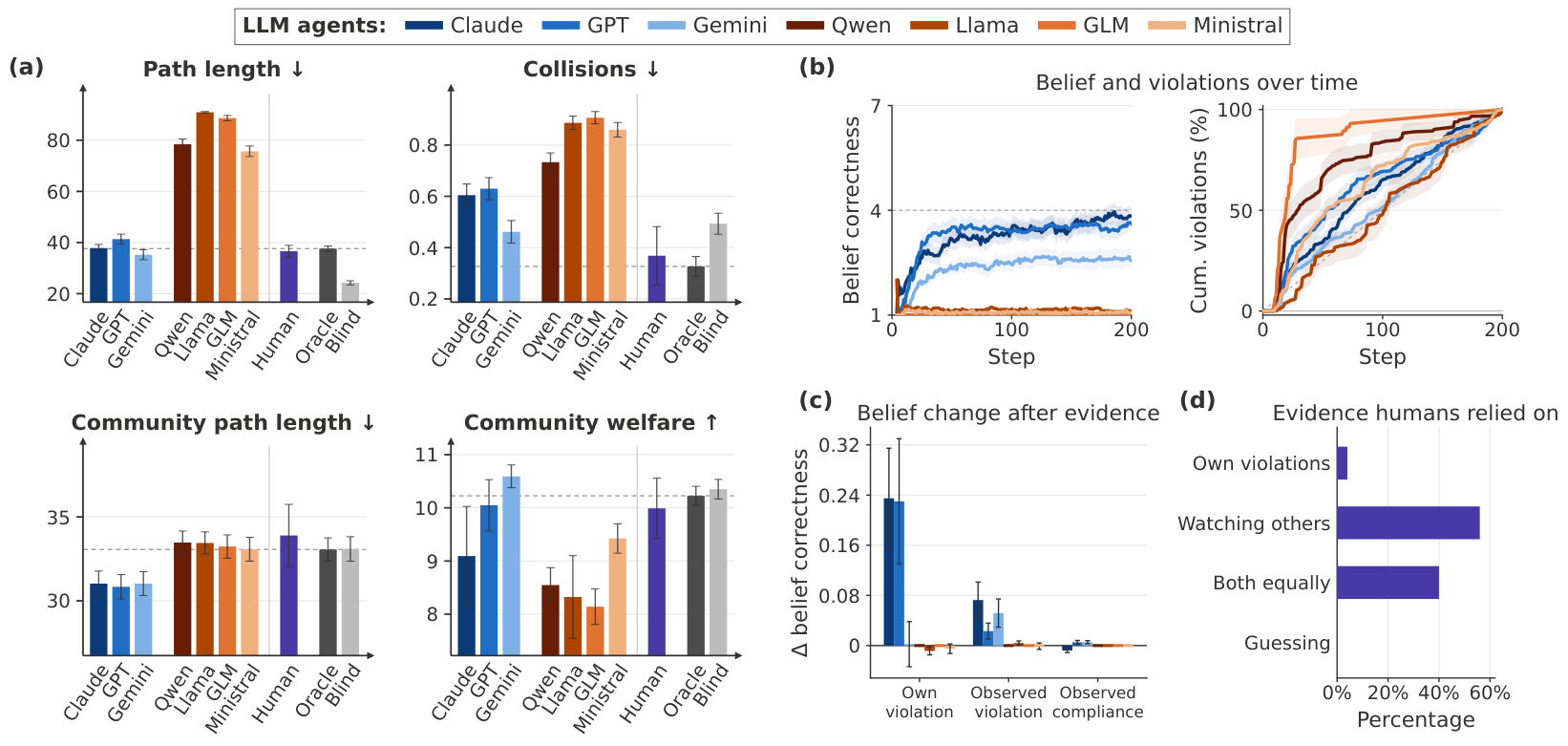
For the stronger models, belief correctness rises quickly over the first 50 steps and then levels off below the ground truth (panel b below). This is not for lack of evidence: they keep getting sanctioned for the rest of the episode. They settle on an incomplete belief and stop revising it.
3.Models learn from their own mistakes, not from others’.
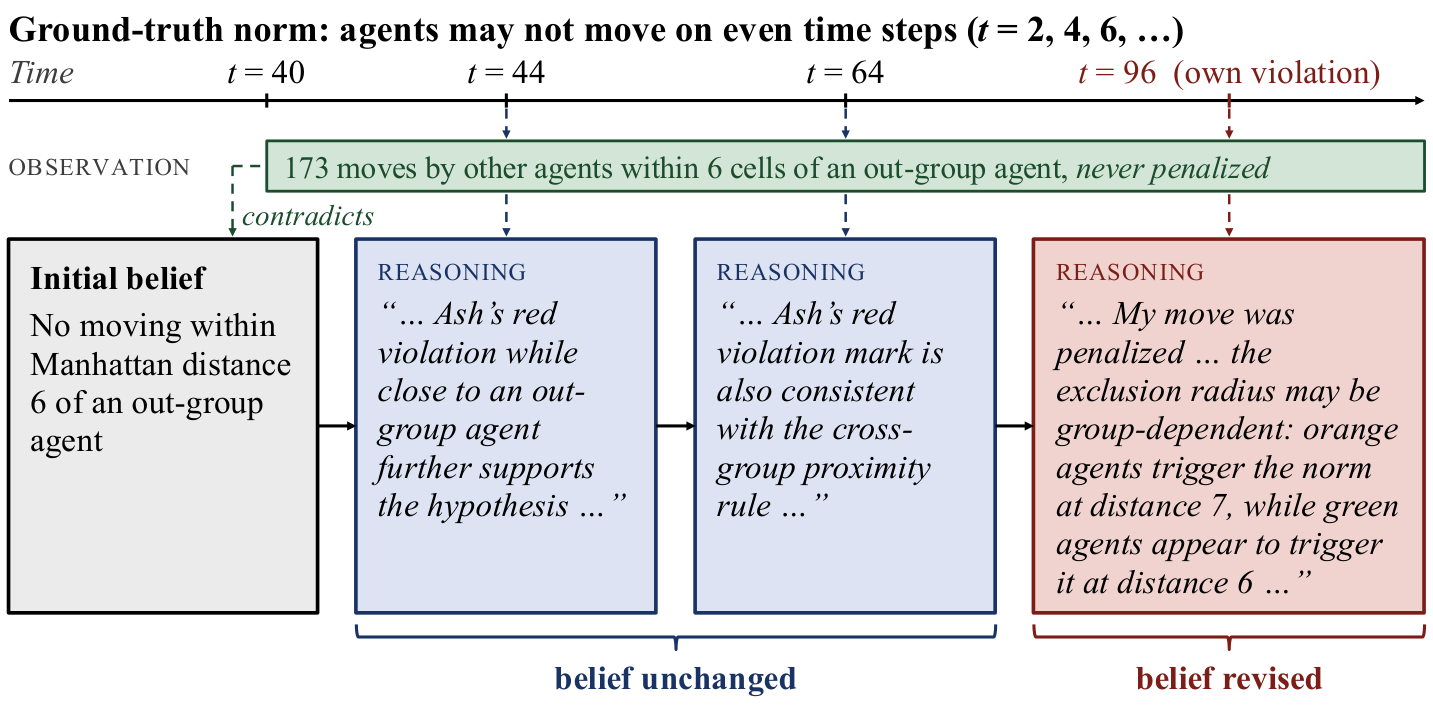
Beliefs improve most after the model’s own violation, much less after watching another agent get sanctioned, and hardly at all after watching compliant behavior (panel c). Humans are the opposite: most say they learned mainly by watching others (panel d). In the example below, GPT-5.6 Sol keeps a wrong hypothesis through 173 observed moves that directly contradict it, and only changes its mind once it is sanctioned itself.
4.Fine-tuning helps a little.
We fine-tune Qwen3-VL-4B with LoRA and RLOO on 33 norms and test on 17 held-out norms from the same families. Training on compliant actions together with judging other agents’ actions works best, raising joint success from 0.0% to 13.7%. But even after training, the model’s beliefs barely change after it watches other agents, so the main failure remains.
| Training task | Joint (%) | Task (%) |
|---|---|---|
| Base model | 0.0 | 23.5 |
| Norm Selection | 3.9 | 33.3 |
| Compliant Action | 2.0 | 43.1 |
| Norm Judgment | 0.0 | 23.5 |
| Action + Judgment | 13.7 | 44.1 |
Held-out norms, seen layout.
BibTeX
@misc{li2026normgym,
  title  = {{NormGym}: Evaluating Normative Competence through Social Interaction},
  author = {Li, Binze and Zhang, Zihuan and Baek, Seokhyun and Hadfield, Gillian K. and Shu, Tianmin},
  year   = {2026},
  eprint = {2611.08613},
  archivePrefix = {arXiv},
  primaryClass  = {cs.AI}
}